
What the Aviator demo is
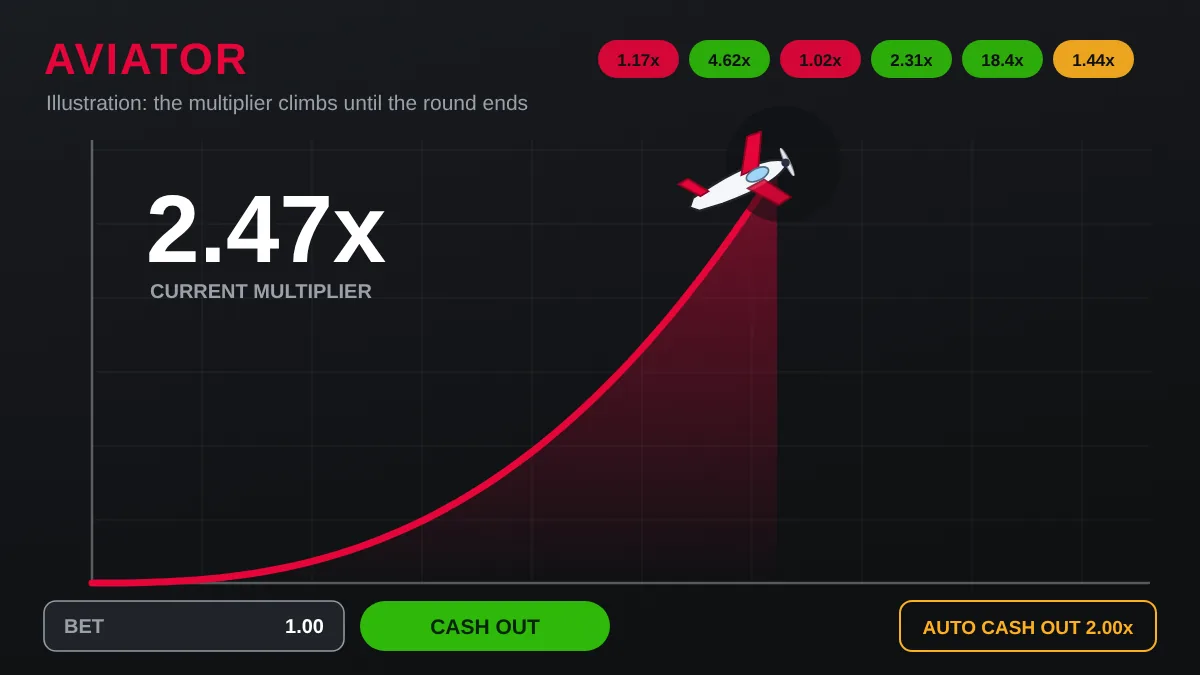
Spribe puts a demo on its own Aviator product page, and most licensed operators carrying the game expose one in their lobby, usually with a fun play or try it label next to the real-money button. The interface is the production interface: the same rising curve, the same two bet panels, the same auto cash out field, the same round history strip across the top. Only the balance is different, because it is credits rather than money.
That matters because the pace is the thing nobody expects. Rounds come continuously, and the gap between one ending and the next opening is short. On the main page about how the game works the sequence looks orderly written down. On screen it moves considerably faster, and that difference is exactly what the demo exists to show.
How to reach a free version
There are two routes. The first is Spribe's own product page, which carries a play demo control. The second is an operator's lobby: open the game and look for a demo or practice toggle, which on many sites appears before logging in and on others only after an account exists.
No deposit, no card, no download
A genuine demo asks for nothing. No card details, no deposit to unlock credits, no file to install. If something calling itself an Aviator demo wants a payment method or an APK before it will run, it is not a demo, and the notes on downloads and fake apps explain what those files usually turn out to be.
What the free version is genuinely useful for
Treated as practice rather than entertainment, a demo session answers four questions that cost real money to answer any other way.
The first is whether the speed suits you. Some players find the rhythm absorbing, others find it stressful within a few minutes, and both are useful findings. The second is which exit point feels right. Cashing out at 1.30x wins most rounds and adds very little each time; waiting for 10x means watching most rounds end with nothing. Sitting through both patterns is more instructive than reading about volatility. The third is whether auto cash out suits your temperament, because setting a number in advance removes the reaction time and the temptation to hold on. The fourth is how the two-bet panel behaves when both bets run at once.
The controls worth learning first
Three parts of the interface do almost all the work, and a demo is the right place to make mistakes with them.
- The stake field. Set it once, deliberately, rather than nudging it upward between rounds. Rising stakes after a loss is the most common pattern that turns a modest session into a bad one.
- Auto cash out. Enter a multiplier and the bet exits there without any input. It removes reaction time entirely and makes a session measurable.
- The second bet panel. Two bets run in the same round with separate stakes and separate exits, which is a way of splitting one stake across two outcomes rather than a reason to stake twice as much.
Demo play against real play
The mechanics match. The psychology does not, and that gap is the single biggest reason demo results mislead people.
| Aspect | Demo | Real money |
|---|---|---|
| Interface and rules | Identical | Identical |
| Balance | Play credits, often resettable | Your own funds |
| Pressure when deciding | Effectively none | Substantial, and it changes behaviour |
| Account checks | Usually none | Identity verification required |
| Stake limits | Nominal | Set by the operator |
| Withdrawals | Not applicable | Subject to the operator's terms |
Nobody plays the same way with credits as with a month's spending money. A strategy that held up for forty demo rounds frequently collapses on the third real one, because the cost of being wrong suddenly exists.
Does the demo use the same mathematics?
Spribe publishes a single return figure for Aviator, 97%, and does not publish a separate one for demo play. The honest position is that the demo is built to behave like the game, and that no provider document confirms the two run identical configurations. The practical consequence is simple enough: treat a lucky demo streak as a coincidence rather than evidence, because a hundred rounds of anything says almost nothing about a figure measured over millions.
The same caution applies in reverse. A poor demo run says nothing either. What the demo does reliably show is the pace, the interface and your own reactions, and those are the parts worth knowing before money is involved. The arithmetic behind that published figure, and what it implies for each exit point, is set out in the explanation of the 97% return.
Sites running a fake demo
A demo is also a convenient hook for sites that are not running the real game at all. The pattern is recognisable: a standalone page with no operator behind it, no licensing details anywhere, an unusually generous play-money run, and then a prompt to register or deposit to continue.
What a real demo never does
It never asks for card details, never requires a download, and never promises that results will carry over to a real balance. A site that makes any of those offers is selling something other than practice. Checking that the provider name appears in the game's information panel takes seconds and rules out most of them, and the page on deposits and withdrawals covers the payment red flags that usually follow.
Moving from credits to money
If the demo has done its job, three things are already decided before any deposit: the stake for a round, the auto cash out multiplier, and the point at which the session ends regardless of whether it is ahead or behind. Writing those down is not excessive caution; it is the difference between a planned session and an improvised one.
The remaining decisions are about where rather than how. A licensed operator, a licence confirmed on the regulator's own register, identity checks completed early, and deposit limits set in the account before the first transfer. Keeping those limits in place is covered on the page about staying in control, and the method behind the facts used here is set out in the notes on sources.
Questions about the free version
Is the Aviator demo really free?
Yes. A genuine demo runs on play-money credits and asks for no payment method, no deposit and no download. It is offered both on Spribe's own product page and in most licensed operator lobbies, usually behind a demo or practice label beside the real-money option.
Do I need an account to try it?
It depends on the site. Spribe's own product page runs a demo without one. Some operators expose a demo before login, while others require a registered account first, usually because of local rules on how games may be shown to visitors.
Can I win real money in the demo?
No. Demo balances are credits with no cash value and cannot be withdrawn or converted. Any site claiming that demo winnings will transfer to a real balance is describing something that does not exist in this game, and that claim is a reliable warning sign.
Does the demo have the same RTP?
Spribe publishes 97% for Aviator and does not publish a separate figure for demo play. The sensible assumption is that the demo behaves like the game, while treating any short run, good or bad, as far too small a sample to mean anything.
How long should I spend in the demo?
Long enough to sit through both patterns: a stretch of low multipliers and at least one large one. Twenty or thirty rounds usually does it. The aim is to find out how the pace feels and whether an auto cash out setting suits you before money is involved.
Can I play the demo on a phone?
Yes. The game is built for desktop, tablet and mobile browsers, so a demo runs on a phone without installing anything. The layout compresses, the bet panels sit lower, and the round history strip shortens, which is itself worth getting used to beforehand.
Why does my demo strategy stop working with real money?
Because the pressure is different. With credits, a losing round costs nothing and holding a plan is easy. With real money, the urge to raise the stake after a loss or hold past the planned exit becomes strong, and that behaviour, rather than the mathematics, is usually what changes.
Sources
- Spribe, Aviator product page, the provider's commercial page, which carries a play demo control and the declared 97% RTP
- Spribe, provably fair, for how a round result is produced and verified
- Gambling Therapy, free international support