
What the Aviator game demo actually is
Spribe hosts a demo of Aviator on the product page for the game itself, and operators carrying the title usually put one in the lobby behind a label such as fun play, practice or try it. The build is the live build: same climbing curve, same pair of bet panels, same auto cash out field, same ribbon of previous multipliers across the top. The balance is the only altered component, and it holds credits with no monetary value.
Why bother at all? Because reading about a two-second round and sitting through forty of them in a row are entirely different experiences. Written out on the page on how rounds work, the sequence looks deliberate and roomy. In motion it is relentless, and almost nobody guesses the tempo correctly in advance.
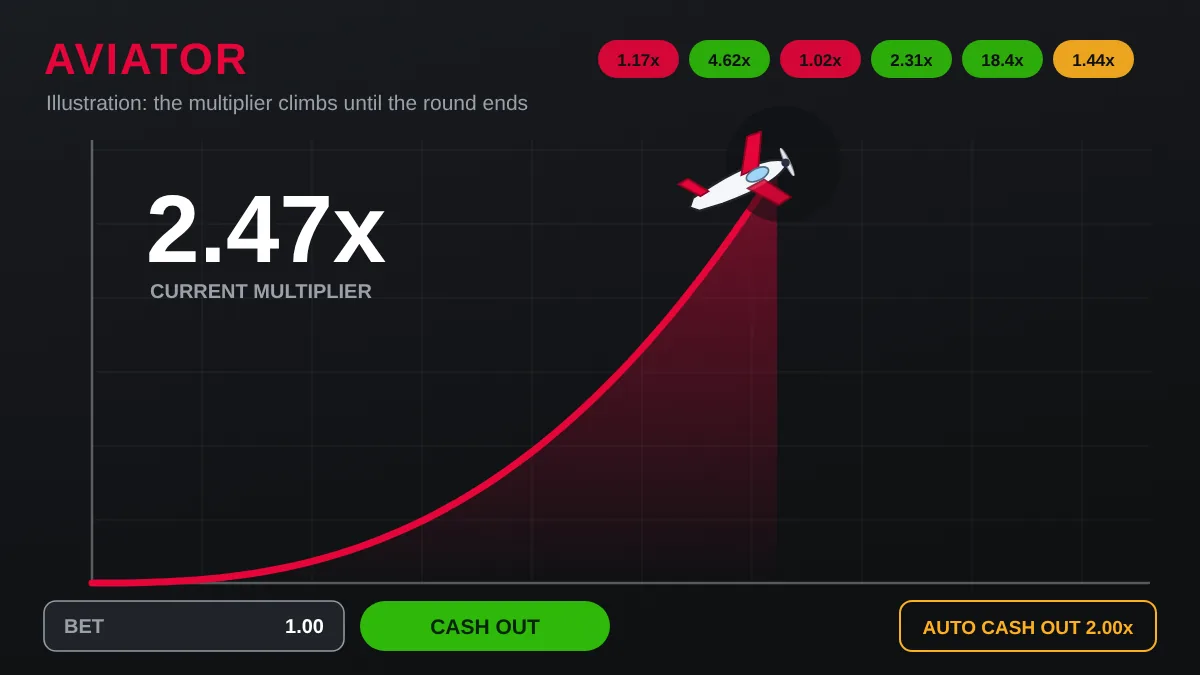
Where the free Aviator game demo runs
Two doors lead in. The provider's own product page carries a demo control that needs no account whatsoever. An operator lobby is the other, where a demo or practice switch sits beside the real-money button; some British sites show it to anybody passing, while others reveal it only once an account exists, which reflects how licensees are expected to present games to visitors.
A real demo asks for nothing
No card number, no deposit to release credits, no installer. Anything calling itself an Aviator demo that wants a payment method or an APK file first is something else wearing the word, and the page on counterfeit apps goes through what those files generally hold.
Four things worth settling before money is involved
Used as a rehearsal rather than a pastime, half an hour of credits answers four questions that otherwise get answered the expensive way, one deposit at a time.
Tempo comes first. Some players find the rhythm gripping and others find it unpleasant inside five minutes, and either answer saves money. Exit discipline comes second: a 1.30x habit collects small wins most rounds, while holding out for 10x means watching round after round finish at nothing, and living through both stretches beats any paragraph about variance. Third is whether a pre-set exit suits you, since typing a number before the plane moves takes the decision away from your thumb. Fourth is the two-panel layout, which behaves quite differently once both bets are running and the curve is climbing.
The three controls that decide the round
Most of the interface is decoration. These three do the work, and credits are the right currency for getting them wrong.
- Stake. Choose a figure once and leave it alone. Creeping stakes after a losing run is the single behaviour that turns an ordinary session into a memorable one, and it is easier to spot in a demo than in a bank statement.
- Auto cash out. Type a multiplier and the bet closes there by itself. Reaction time stops mattering and the session becomes something that can be measured afterwards instead of recalled.
- The second panel. A round can carry two bets, each with its own stake and its own exit. It is a device for splitting one stake in two, not permission to double it.
Aviator game credits against real cash
Mechanically the two are the same. Psychologically they are not, which is why a strong demo run makes such poor evidence.
| Element | Playing credits | Playing money |
|---|---|---|
| Curve and rules | Unchanged | Unchanged |
| Balance | Pretend, usually resettable | Yours |
| Cost of a late exit | None | Real, and felt |
| Account formalities | None | Age and identity confirmed first |
| Funding | Nothing to fund | Debit card, transfer or wallet |
| Cashing out | Meaningless | Governed by the operator's terms |
Nobody behaves identically when the chips are notional. A rule that survived sixty practice rounds can fail on the second paid one, because being wrong has acquired a price.
Does the demo use the same 97% maths?
Spribe prints one return figure for Aviator, 97%, and prints nothing separate for demo play. The defensible position is therefore that the free version is built to behave like the paid one, while no provider document confirms the two are configured identically. What follows from that is modest: a hot streak on credits is a coincidence rather than a finding, because a hundred rounds say essentially nothing about an average computed over millions.
The reverse holds just as firmly. A miserable practice run proves nothing either. Tempo, layout and your own reflexes are what credits measure reliably, and those are precisely the things worth knowing in advance. For what the 97% figure implies at each exit point, the arithmetic on the main page works it through.
Fake Aviator game demo pages
The word demo also makes convenient bait. The shape is always similar: a page with no operator behind it, licensing details nowhere on the site, a suspiciously kind run of practice results, then an invitation to register or deposit before continuing.
Three things a genuine demo never does
It never collects card details, never insists on a download, and never suggests practice winnings will become spendable. Any of the three marks a page selling something other than rehearsal. Reading the provider name out of the information panel takes seconds and eliminates most of them, and the page on deposits and payouts lists the money warning signs that tend to follow.
Moving from free credits to real money
A demo that has done its job leaves three figures already decided: the stake per round, the exit multiplier, and the loss or the clock at which the session finishes whatever the balance is doing. Writing them down somewhere is not fussiness; it is the difference between a session with a shape and a session without one.
After that the questions are about venue rather than technique. An operator licensed by the Gambling Commission, the licence looked up on the public register rather than taken from a footer, age and identity confirmed early, and a deposit limit set before the first transfer. Holding those limits once play starts is the subject of the page on limits and support, and where the facts here come from is laid out in the sourcing notes.
Aviator game demo questions
Is the Aviator demo genuinely free?
Yes, in the sense that matters: credits have no cash value and nothing is asked for in exchange. No card, no deposit, no installer. Both the provider's product page and most licensed lobbies carry one, usually tucked behind a practice or fun play label.
Do I need an account first?
On the provider's own page, no. At an operator it varies. Some British sites expose a demo to any visitor while others open it only after registration, which comes down to how a licensee has chosen to present games to people who have not yet signed up.
Can practice credits turn into real money?
Never. A demo balance is a counter with no cash value behind it, and nothing in the game converts one into the other. A site promising that practice winnings will become withdrawable is describing a feature that does not exist, which is a dependable signal to leave.
Does the free version use the 97% return?
Spribe publishes that figure for Aviator and publishes no separate one for demo play, so the reasonable assumption is that the demo behaves like the game. Either way, a run of twenty or fifty rounds is far too small to reveal anything about a long-run average.
How long should a practice session last?
Long enough to live through two different stretches: a sequence of early crashes and at least one multiplier that climbs a long way. Twenty or thirty rounds usually covers both. The point is learning the tempo and testing a pre-set exit, not building a record.
Will it run on a phone?
Yes. The game is built for mobile browsers alongside desktop and tablet, so nothing needs installing. The panels stack, the multiplier ribbon shortens and the cash out button grows, and getting used to that compressed layout on credits is easier than discovering it mid-session.
Why does a plan that worked on credits fall apart with money?
Because the cost of patience changes. With pretend credits a lost round is an abstraction, so sticking to a stake and an exit is effortless. With a real balance the pull towards one more round at a bigger stake arrives, and behaviour rather than mathematics is what gives way.
Sources
- Spribe, Aviator product page, the provider's own commercial listing, which carries both a demo control and the 97% figure
- Spribe, provably fair, on how a result is produced at the start of a round and checked afterwards
- Gambling Commission public register, the place to confirm an operator licence is live before depositing
- GamCare, free and confidential help on 0808 8020 133 at any hour